Showing posts with label art advice. Show all posts

Saturday, December 21, 2024

you know it's hard out here for an artist


The year is winding down and I have received what is probably the final art notification of the year.  I guess that means we have to try to make sense of this again.


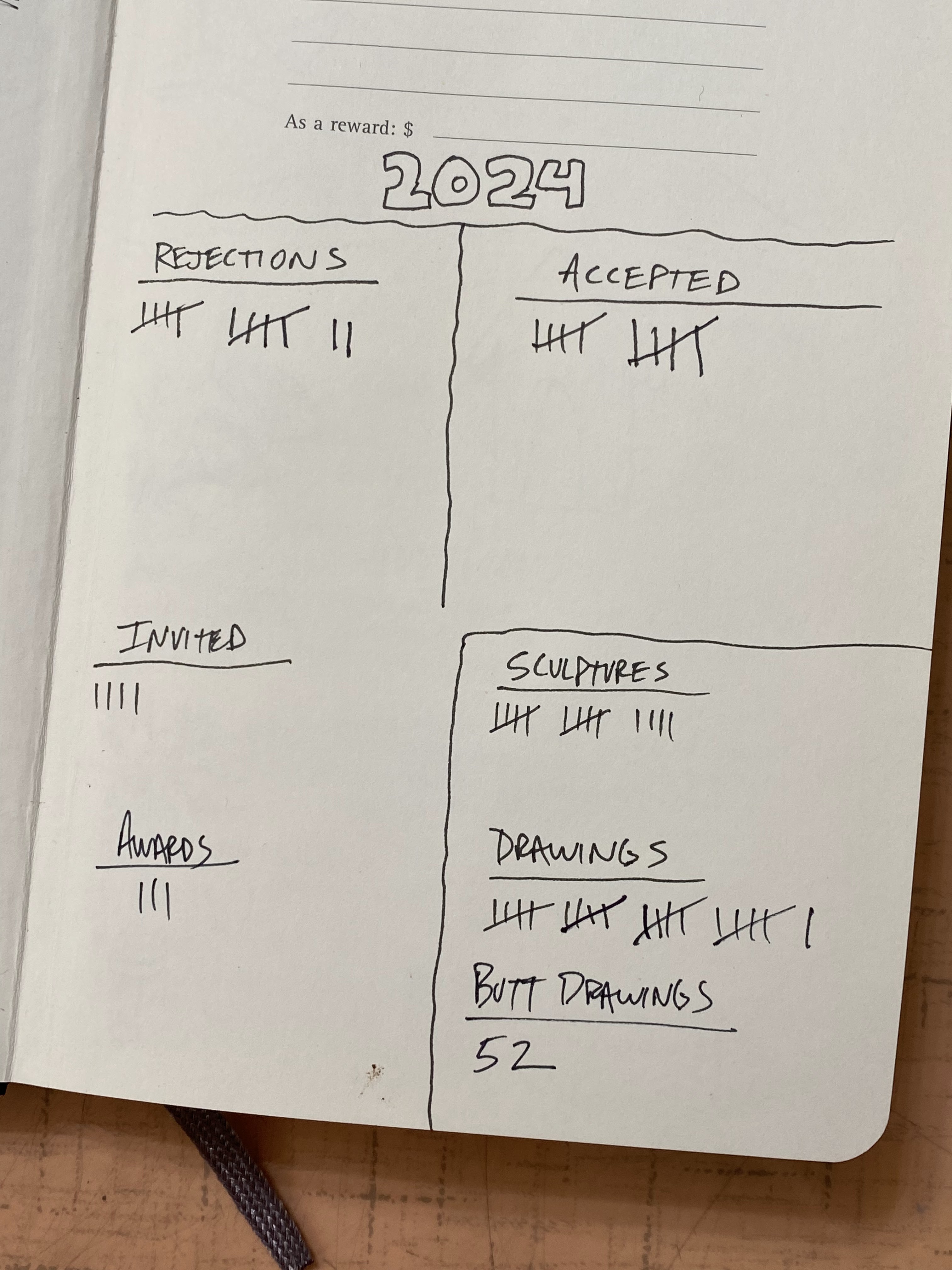
Here’s this year’s stats:

12 rejections

10 acceptances

4 invitations to exhibit

3 awards

3 solo exhibits

14 new sculptures created

21 new drawings created

52 new butt drawings for fun


The reason I began keeping up with these numbers a couple of years ago was so that I could have a record of what actually happened to compare with what I “felt” happened.  Because, you know, feelings are kind of lies.  

Let’s start with the big ones, the rejections and acceptances.  We learned last year that I can’t really do percentages on my own but 12 rejections and 10 acceptances is pretty good.  One of my former students quickly pointed out that this was better than the 90% rejection rate I tell my students to expect.  This is true, but I’m also not just starting my career as all of them are.  Their valid point was, these numbers are pretty good.  I’m very happy with getting into 10 juried exhibits in 12 months.  For my academic friends, many of these were Level 1 accomplishments for university service.

If we look at the other numbers and we do a quick comparison with my peers who are working at similar jobs and have similar goals, the numbers are pretty high.  I’m comfortable looking at that list and concluding that I had a very good year as an artist.  


But let me tell you about a Tuesday in the spring.  I had two solo shows approaching and I was making art like a machine while teaching a very busy spring semester.  I had begun posting new work on Instagram on Tuesdays and this particular Tuesday I didn’t quite have a new work finished.  I woke up filled with feelings of inadequacy.  I wondered if I was working hard enough.  Was I doing enough?  I felt slack.  I felt like my artist friends were killing it and I was not.  

Then there was the night of the reception for my second solo show.  Maybe 8 people showed up.  I felt like a failure.  I felt like a loser.  I felt like my work was stupid, I had wasted my time and now I had to drive 3 hours home.  What was the point?  

And what about last week when I received another rejection from that show I enter every year and can’t seem to get into?  I felt like my work wasn’t any good and that I wasn’t doing enough.  

Oh, and what about this week when I read one negative student comment about my teaching and immediately forgot all about being awarded some kind of teacher of the year award.  Feelings, right?  They'll get us focused on the few negatives and cause us to ignore all the positives.  

The facts said one thing and the feelings said another.  Living in the confines of a human brain can be such an irritating thing.  I can open my sketchbook and see the facts.  I can think back and remember the new friends art has brought into my life this year.  I can recall specific kind words viewers have spoken to me.  I can remember selling works to people who decided to wake up every day and see my art.  And still, my brain said that I was a loser.  


Art isn’t for wimps, y’all.  If you want an easy life filled with confidence and constant reassurance, please look elsewhere.  I’ve had a stellar year by almost any standard and still I’ve had many moments of crippling doubt and insecurity throughout the year.  Keeping up with this list provides me immediate access to clarity and factual data any time I need it.  Sharing it publicly provides my peers and art friends input from a brother in arms and provides a glimpse into the very real part of being an artist that few people discuss.  

If you’re a younger artist, maybe a current or former student or a creative of any kind, here’s a truth for you to chew on:  The self-doubt doesn’t go away when you accomplish some goal.  The imposter syndrome doesn’t fade at a certain age.  In fact, I think we need to change our perspective on these topics.  Self-doubt is a normal part of being a human.  Imposter syndrome is not an abnormality or a problem to be solved, but rather, it is a very real and helpful feeling we decided to name.  If you can reframe these things and stop seeing them as problems, you can free yourself from any negative feelings surrounding those feelings.  You have self-doubt?  Cool, that means you’re putting yourself out there as a creative.  Feeling like an imposter?  Awesome, that means you’re in a position to take some risks and be who you really are.  Congratulations on both.  


If you're not currently keeping a computer file or an old fashioned list in your sketchbook or journal of positive things that happen to you, maybe give that a try in this new year.  Someone give you a compliment?  Write it down.  Get into a show?  Write it down.  Someone tell you that you inspired them or made them smile?  Write it down.  Then when you wake up in a cold sweat thinking you've been wasting your life, you'll have the factual information you need to fight those lying feelings off.  


Sunday, July 7, 2024

who do you think you are?

I was recently invited to be on a panel of artists from South Carolina to discuss creativity, sustainability and care as each topic relates to artists and their work.  This was a “homecoming” event created by the SC State Museum, designed to bring the state’s artists and creatives together to be encouraged and edified.  

These three topics are more or less continually on my mind as an educator of college level artists.  Each year I have the privilege of teaching young artists how to adopt healthy studio practices as they prepare for creative lives after graduation.  Part of my preparation for teaching includes staying current on best practices for artists in terms of mental and emotional health.  

In this role as an educator, I have to be careful to balance my personal thoughts and beliefs with the current social dialog and research.  As an older white male who was raised in the conservative South, I tend to see things a bit differently than many of my younger generational students.  My goal is to provide honest and helpful advice that I actually believe in.  Sometimes, this advice runs in opposition to the trending social media hashtags, “hacks” and sound bites.

I understood my role on the panel and how it differed from my role as an educator.  On the panel, I was among peers who had very different life experiences, backgrounds and thus, advice.  I was happy to offer my take while completely absorbing theirs.  Many of them offered helpful and evidence based suggestions and I hope to share some with my students next year.  I was happy that the suggestions and discussion points at this event were not just regurgitations of social media psychology and I hope that the SC State Museum will continue to host events like this in the future.


In the past few months, I’ve had more personal discussions with fellow artists about my work ethic, my general approach to studio practice and mental and emotional health.  I am careful to make sure these friends understand that the advice or experiences I share are mine and that I only know that they work for me.  I understand that I am different from you and pretty much everyone else.  Like all the advice that we get, we should take what works for us and flush the rest.   

Another thing to consider is that my advice may change radically over time.  Let me explain…

In January of 2020, I started to have a bit of a moment with myself.  I had just finished several seasons of a long, drawn out TV show and I realized I had quite literally wasted many digits of hours sitting on my butt, watching someone else tell me a story.  I kept thinking that my time would have been better spent telling my own stories, and starting on January 1, that’s what I set out to do.  By the time the world shut down in March, I had completed more new drawings than I had completed in recent years.  

Being “forced” to be at home for the next 3 months heightened my awareness that I would not live forever and that, as an artist, I had work to do while I was here.  I listened to a lot of music, I had a lot of fun outside, I spent a lot of time with my family and I created a LOT of art that year.  I did not watch TV.  

In the months that followed, I happily told people who asked (and many students who did not ask) that the TV was their enemy.  This included YouTube, as I was just learning then that a whole generation of Americans had grown up depending on YouTube for everything from movies to TV shows, to DIY shorts.  It was amazing to me how many hours they could watch YouTube in one day.  

Full disclosure here:  I have a long-standing beef with the TV.  In college, I sort of woke up to the fact that my roommate and I were spending hours a day watching shows and movies in our dorm and only spending a fraction of that time working on our studio art projects.  I did a little research on the topic for an Education course and immediately swore off the TV for the last 2 years of undergrad.  To this day, I’m more of a deliberate TV viewer.  I hate the idea of having the TV on for “noise” and I still believe that watching TV so much makes you dumber.

I understand that we need to update our terms for the world we currently live in.  What I would have considered “TV” back in the day, could now easily be broadened to include video games, social media or simply “screens”.  To the creative mind, all of these are obstacles that stand between you and a healthy studio practice.

When my kids grew into teenage years and started trending towards self-isolation in their rooms, the TV became a way of luring them out and spending some fun time together.  My daughter and I started watching silly things together and this became a nightly habit.  Soon we lured my son out of his room to join us and to this day, we have a pretty regular nightly time together watching something on the big screen in the living room.  

So if you ask me today if you should spend time every night watching TV, I would tell you no.  I would suggest that doing so would be an impediment to a healthy studio practice for most artists.  And I might even tell you this while I’m sitting in front of the TV, spending time with my kids.  Because for me, right now, this is the healthiest thing I can be doing.  

Of course, I’m also disciplined enough to set aside a large amount of time each day for creative work.  I’m still creating unprecedented amounts of new drawings and sculptures and also having a very respectable number of exhibits of my work.  I know what I can do and how I can carve away time to spend with my family.  Just like GI Joe said in those 1980s feel-good commercials, “knowing is half the battle”.  

I can talk with a middle aged artist and suggest that the way to stay healthy as a creative is to know yourself and schedule your days accordingly.  I can assume that in 40 or 50 years of practicing being a human, that the other person has a pretty good idea of who they are.  This doesn’t work as well with 20 year old students.  But perhaps this is a good reminder for us all.


I don’t have the advice you need to be successful.  The 20 year old YouTuber or IG influencer doesn’t have the answer to your problems.  What works for us may not work for you.  In fact, it most likely won’t.  We are different people with different experiences and different needs.  Yes, TV will actually rot your brain (and habitual viewing is also terrible for your physical health) but there are days when watching a funny show for 15 minutes is exactly what you need.  I work and go all the time but if you try that, you might die, and I’m only half kidding.  

What we all need is to know ourselves.  Be honest with yourself.  What do you want?  What are you willing to do to get it?  Did you make progress toward it today?  What will you do to make progress toward it tomorrow?  Is what you’re doing right now helping?  Are you treating yourself in a sustainable way to reach your goals?  


Another thing that deserves its own paragraph is that you are constantly framing your own narrative.  If you see yourself as not being enough, not being lucky, not being successful, you will become all those things.  If you see yourself as hard working, grateful, blessed and achieving, you will become all those things.  Take a day and pay attention to yourself narrative.  How do you talk to yourself?  How do you tell your story to your friends and family?  You are in the process of telling your story.  It will eventually happen just as you’re telling it.  See yourself as meeting your goals through discipline and hard work.  See yourself treating yourself well and being kind to yourself.  You will become your story.